1. System Architecture & Real-Time Safety Principles
ManQ-PsyGate is engineered from the ground up in native Rust as a zero-compromise real-time audio instrument. Built with the nih-plug framework and hardware-accelerated egui rendering, it provides extreme low-latency performance on modern 64-bit operating systems.
Core Real-Time Audio Constraints
Audio thread dropouts and jitter are catastrophic in live performance and heavy DAW arrangements. PsyGate adheres strictly to the four golden rules of real-time audio safety:
Zero Heap Allocation on Audio Thread: No Vec, Box, String, or heap allocations occur inside Plugin::process(). All internal delay lines, Bezier lookup tables, and filter state buffers are pre-allocated during plugin instantiation.
Zero Thread Blocking: Mutex locks, Read-Write locks, thread sleeping, file I/O, and disk logging are completely banished from the audio thread. Thread synchronization occurs exclusively via lock-free atomic arrays (AtomicF32, AtomicBool, AtomicU32).
Mandatory Parameter Smoothing: All continuous host-automatable parameters are processed through 20 ms S-curve exponential smoothers, completely preventing zipper noise, pops, and DC clicks during aggressive DAW automation sweeps.
Zero-Latency DSP: PsyGate reports 0 samples of internal lookahead latency to the host DAW, ensuring seamless integration with live MIDI controllers and multi-track audio bus inserts.
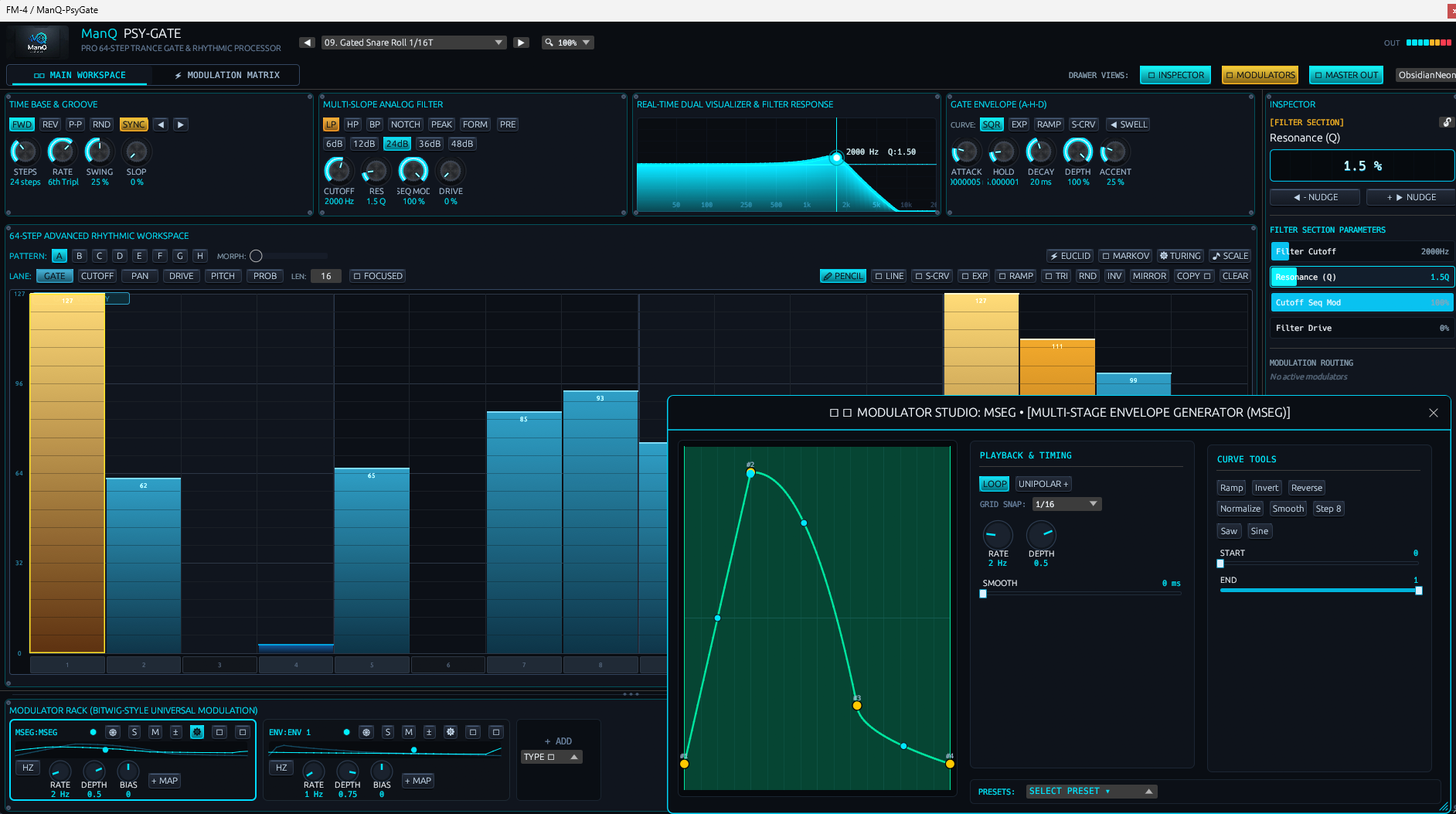
Figure 1.0: Master chassis interface architecture. Top dock header houses the preset browser, navigation tab bar, and UI scaling engine.
2. Master Chassis Layout & Navigation Controls
The user interface follows the unified ManQ Chassis Framework, organized into four primary functional docks:
Chassis Area
Screen Zone
Included Modules & Interactivity
Master Header Dock
Top Strip
Brand emblem, Preset Selector (with mandatory INIT DEFAULT), UI Scale Selector (75% to 200%), Main Workspace / Modulation Matrix Tab Bar, Master Output Gain & Mute, and Drawer View Toggles.
Central Synthesis Panel
Center View
64-Step Multi-Lane Sequencer Canvas, Lane Selector Tabs, Generative Mutation Tools, Filter Cutoff/Resonance/Drive/Slope dials, and Real-time Excursion Visualizer.
Bottom Modulator Drawer
Bottom Dock
Dynamic 8-slot modular rack housing LFOs, MSEGs, Chaos Attractors, Envelope Followers, and Sample & Hold modules with real-time vector oscilloscopes.
Contextual Inspector
Right Column
Focus-driven parameter diagnostics, exact floating-point OLED displays, value nudge steps (+/-0.1%, +/-1%, +/-5%), and active modulation route mappings.
3. 6-Lane Multi-Metric Step Sequencer Grid
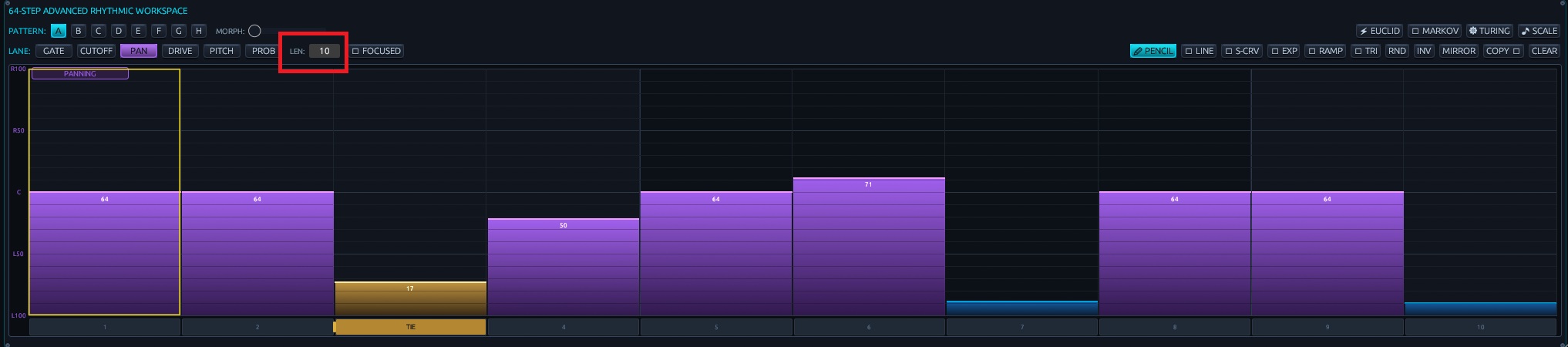
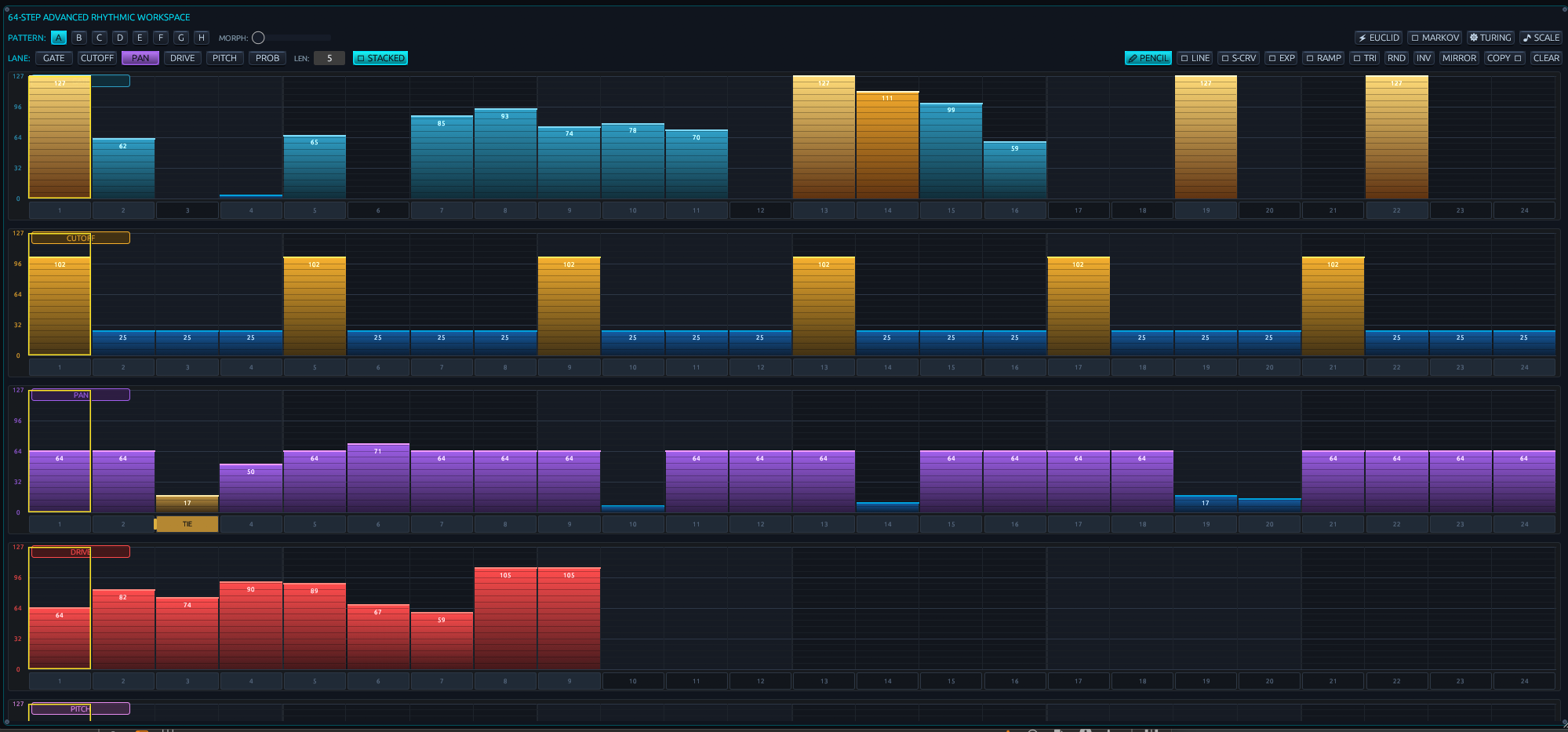
The central sequencer engine allows editing up to 64 steps across 6 dedicated, parallel parameter lanes. Each lane operates with an independent loop length (2 to 64 steps), enabling complex polyrhythmic and polymetric phasing cycles that never repeat identically.
Lane Name
Range / Units
DSP Action & Routing
Gate / Vel
0% to 100%
VCA amplitude envelope gating. Lower edge contains a dedicated Tie Indicator (_ / ⌒) for binding adjacent steps into continuous legato notes.
Cutoff
20 Hz to 20 kHz
Step-sequenced analog filter cutoff frequency modulation with adjustable bipolar envelope depth.
Pan
-100% to +100%
Step-sequenced stereo balance placement using constant-power panning laws.
Drive
0% to 100%
Per-step harmonic saturation drive feeding into the analog non-linear filter core.
Pitch
-24 to +24 st
Monophonic pitch transposition with musical chromatic quantization for arpeggiated melodic sequences.
Probability
0% to 100%
Deterministic step trigger likelihood. At 100%, the step always triggers; at 50%, it acts as a generative coin-toss.
Figure 3.1: Polyrhythmic multi-lane sequencer workspace displaying independent step lengths and per-lane modulation curves.Figure 3.2: Detailed multi-lane editor view showing velocity levels, legato tie nodes, and real-time step playhead tracking.
🖱️ Sequencer Mouse Gestures
Left Click + Drag: Paint step velocity/level values smoothly across multiple steps.
Right Click on Step: Toggles step active state (0% to 100%).
Click on Step Bottom Bar: Toggles Legato Tie with the subsequent step.
Directly above the step sequencer grid sits the Generative Mutation Toolbar, providing instant mathematical transformations of the active pattern lane:
🎲 Randomize: Generates musically weighted random velocity curves constrained to rhythmic sub-grids.
🔄 Invert: Flips the step values vertically across the center axis.
◀ Shift / Shift ▶: Circularly rotates the active pattern one step backward or forward in time.
🌊 Euclidian Generator: Evenly distributes pulses across the active lane length using the Euclidean algorithm.
🧬 Turing Machine Shift Register: Generates evolving, semi-repeating probabilistic sequences based on linear-feedback shift register (LFSR) entropy with controllable lock/mutate rates.
🕸️ Markov Groove: Generates organic velocity accents based on transition probability matrices modeled from real human rhythm performances.
🧹 Clear: Resets all steps in the active lane to clean zero baseline.
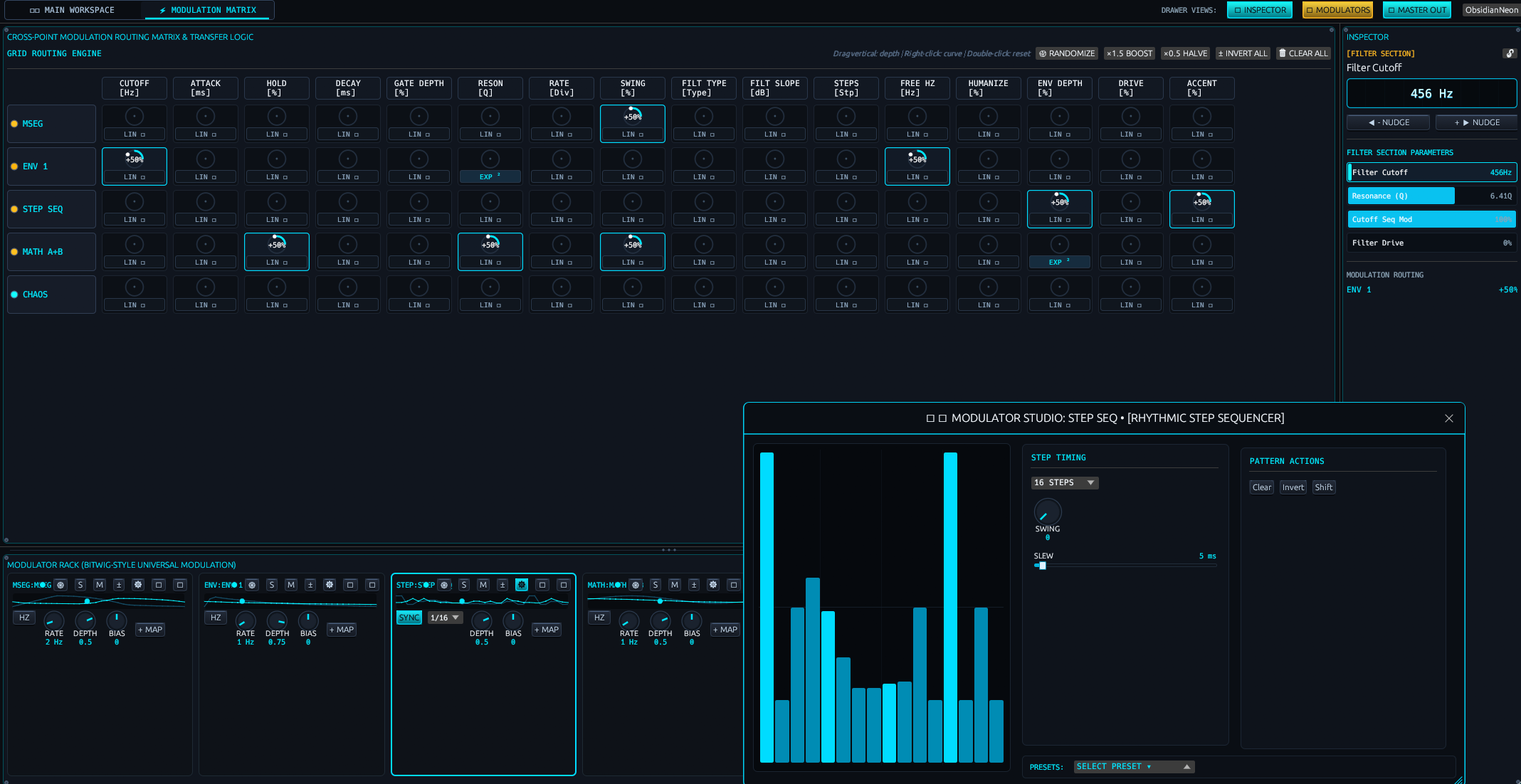
6. Universal Cross-Point Modulation Matrix & Transfer Curves
Navigating to the ⚡ MODULATION MATRIX tab exposes the master cross-point grid routing any of the 8 modular sources to all synthesis targets.
Figure 6.1: Universal Modulation Matrix cross-point grid with real-time animated excursion needles, depth percentage readouts, and neon transfer shape selectors.
Cross-Point Socket Controls
Top Dial Region: Left-drag vertically to adjust bipolar modulation depth (-100% to +100%). Single left-click toggles route active state (+50% / 0%). Double-click resets to 0%. Right-click opens the contextual transfer menu.
Bottom Dedicated Curve Button: Single left-click instantly cycles through the 6 mathematical transfer curves with dedicated neon color badges:
Curve Acronym
Formula Shape
Behavior & Sonic Result
LIN ∿
Linear 1:1
Linear 1:1: Direct proportional transfer. Output tracks the modulator value linearly.
EXP ²
Cubic Exponential (x³)
Exponential: Soft, subtle response at low levels with sudden, intense peak punches. Ideal for snappy percussive envelopes.
LOG √
Cube Root (x^0.33)
Logarithmic: Instantaneous attack rise that dwells in a broad upper plateau. Ideal for rapid gate opening and sustained body.
SIG ⚡
Hermite S-Curve
Sigmoid S-Curve: Dwells quietly at minimum, executes a sudden transitional jump across the center threshold, and clamps at maximum.
ST4 ☷
Quantized 4-Step
Stepped 4-Level: Quantizes the continuous modulation signal into 4 discrete staircase steps (0%, 33%, 66%, 100%).
ST8 ☷
Quantized 8-Step
Stepped 8-Level: Quantizes the modulation signal into 8 rhythmic micro-steps for retro sample-and-hold stepping.
7. Bitwig-Style Modular Drawer & Deep Studio Popups
The bottom drawer houses up to 8 dynamic modulator slots. Clicking + ADD MODULATOR allows inserting any generator type:
Wave Morph LFO: Multi-waveform oscillator (Sine, Triangle, Saw, Square, Exponential, Random Sample & Hold) with pulse-width modulation, phase offset, and tempo sync (4/1 to 1/64).
Chaos Attractor: Non-linear deterministic dynamical systems based on Lorenz, Rossler, and Duffing equations for organic, never-repeating modulation drift.
Envelope Follower: Sidechain-capable peak amplitude tracker with independent Attack (0.5 to 500 ms) and Release (5 to 2000 ms) ballistics.
Sample & Hold / Slew: Clock-sampled noise with variable slew limiter rate for smooth organic drifting or stepped glides.
Clicking any knob or slider across the interface immediately focuses the parameter inside the Right Inspector Column:
OLED Numerical Readout: High-precision numerical value display in exact musical units (Hz, dB, ms, %, st).
Value Nudge Strip: Instant step increment/decrement buttons (+/-0.1%, +/-1.0%, +/-5.0%).
Modulation Mapping List: Lists every modulator actively routed to the focused parameter with individual depth meters and quick mute toggles.
Host DAW Automation: All primary macro parameters are registered as native 64-bit automatable DAW parameters. Pattern banks (A–H) can be automated seamlessly via the host parameter pattern_bank.
PsyGate features an integrated bank of 8 in-memory pattern memory slots (A–H). Producers can switch instantly between different rhythmic variations during a live performance or drop. To avoid host freezes and DAW undo flooding, individual step cells are stored in fast in-memory buffers while the active pattern bank is exposed as the automatable parameter pattern_bank (0 to 7).
Every preset library includes a mandatory INIT DEFAULT state to restore all engine controls to clean baseline defaults.
10. Inter-Plugin Communication Bus (IPC) & Channel Synchronization
PsyGate incorporates a global lock-free 16-channel Inter-Plugin Communication (IPC) bus. When multiple ManQ plugins are loaded across different tracks in a DAW project, assigning them to the same IPC Channel (1 to 16) allows:
Shared Transport Coordinates: Exact beat position and sub-sample tempo synchronicity.
Cross-Plugin Envelope Following: Track 1 (e.g. Kick Drum) can broadcast its audio envelope follower into Channel 1, allowing PsyGate on Track 2 (e.g. Synth Pad) to duck or gate automatically without complex DAW sidechain routing.